For teachers whose AI assistant keeps answering like it has never met their class.
Prompts built for teacher tasks, with your grade, subject and class profile already filled in. Copy one, paste it into the AI assistant you already use, and check the result with the guide. No student names needed.
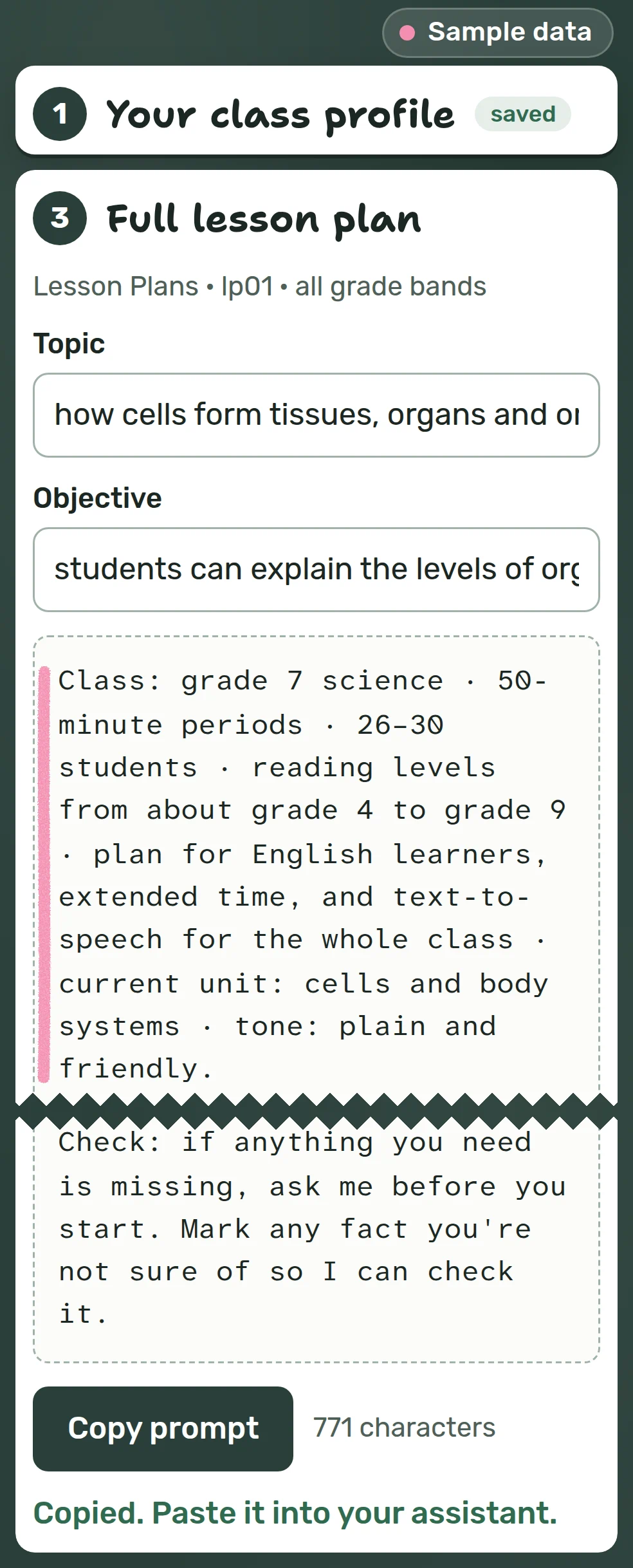
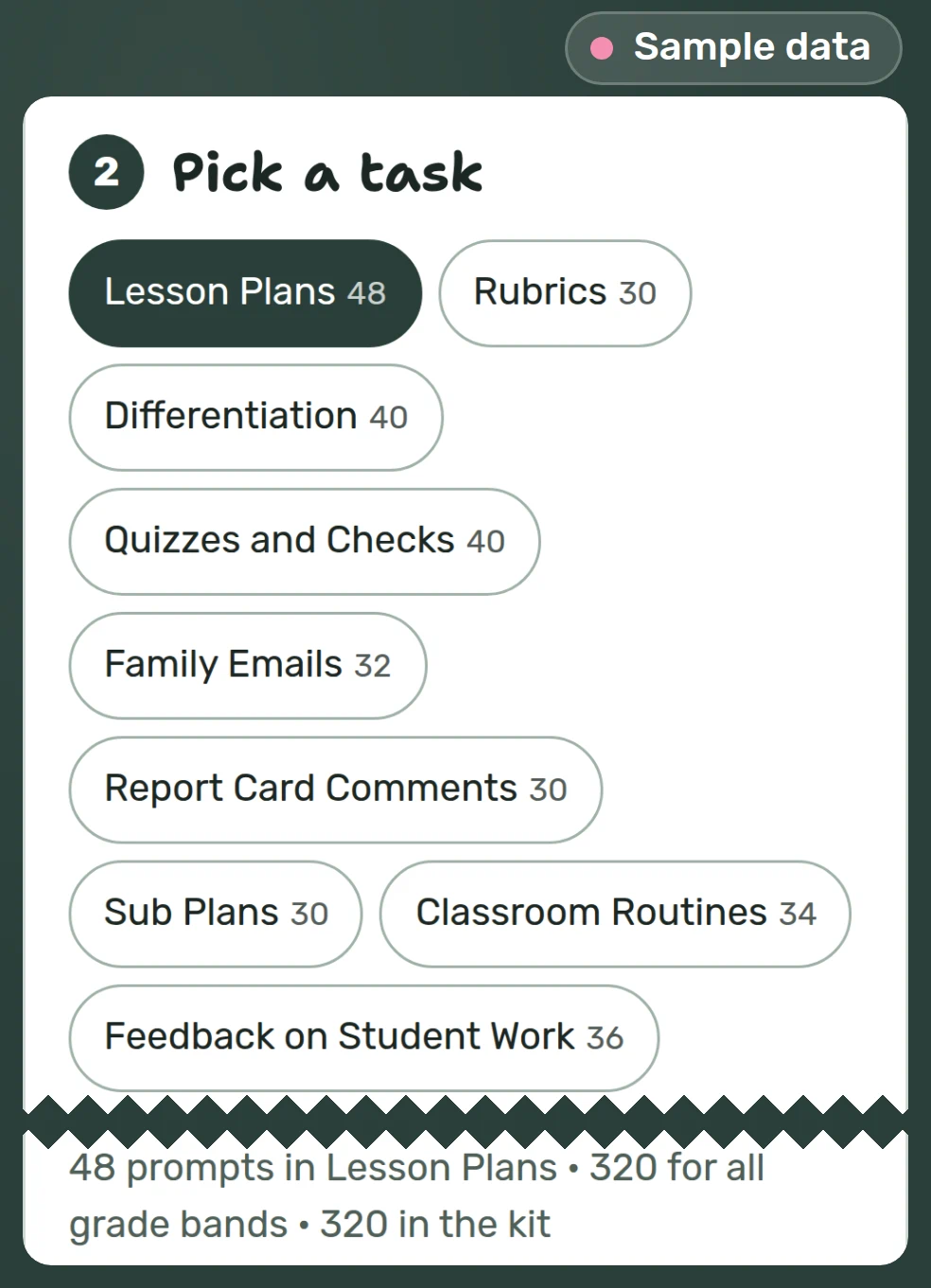
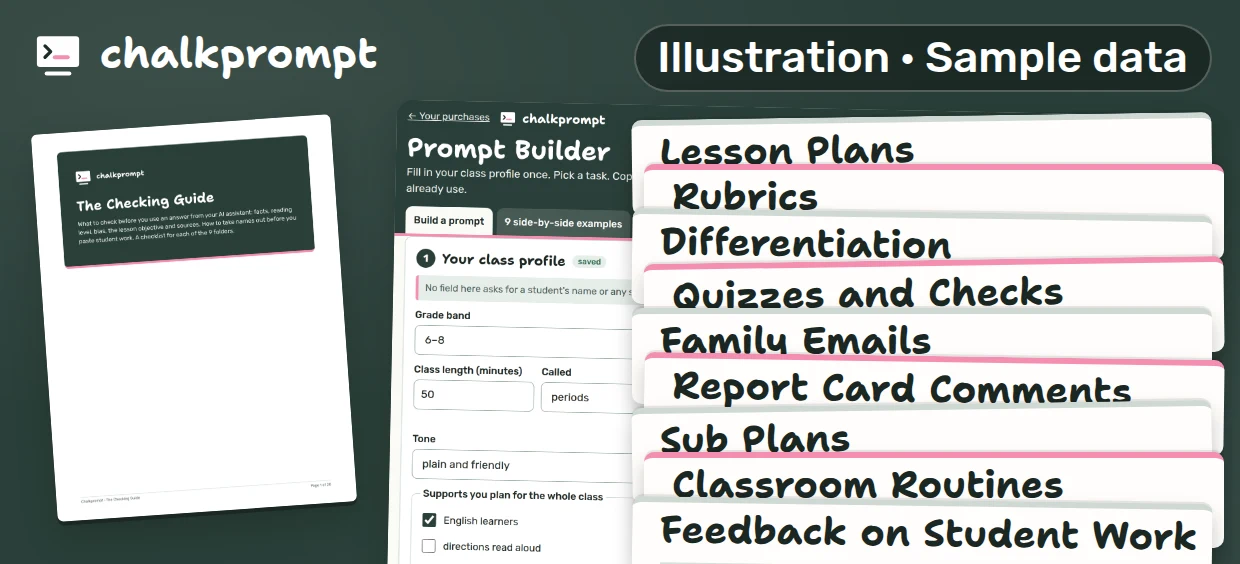
Screenshot of the Prompt Builder, with a made-up example class.
Why the answer comes back generic
An AI assistant answers the request it gets. "Write a lesson plan about cells" arrives with no grade, no class length, no reading levels, no supports and no unit. The assistant fills those gaps with an average: an average grade, an average period, an average class. That average is the generic answer.
Put your class into the request, and the answer starts from your class instead of the average. But it's the same eight details every time, so it's the first thing to go when the week is full.
Class Profile Prefill
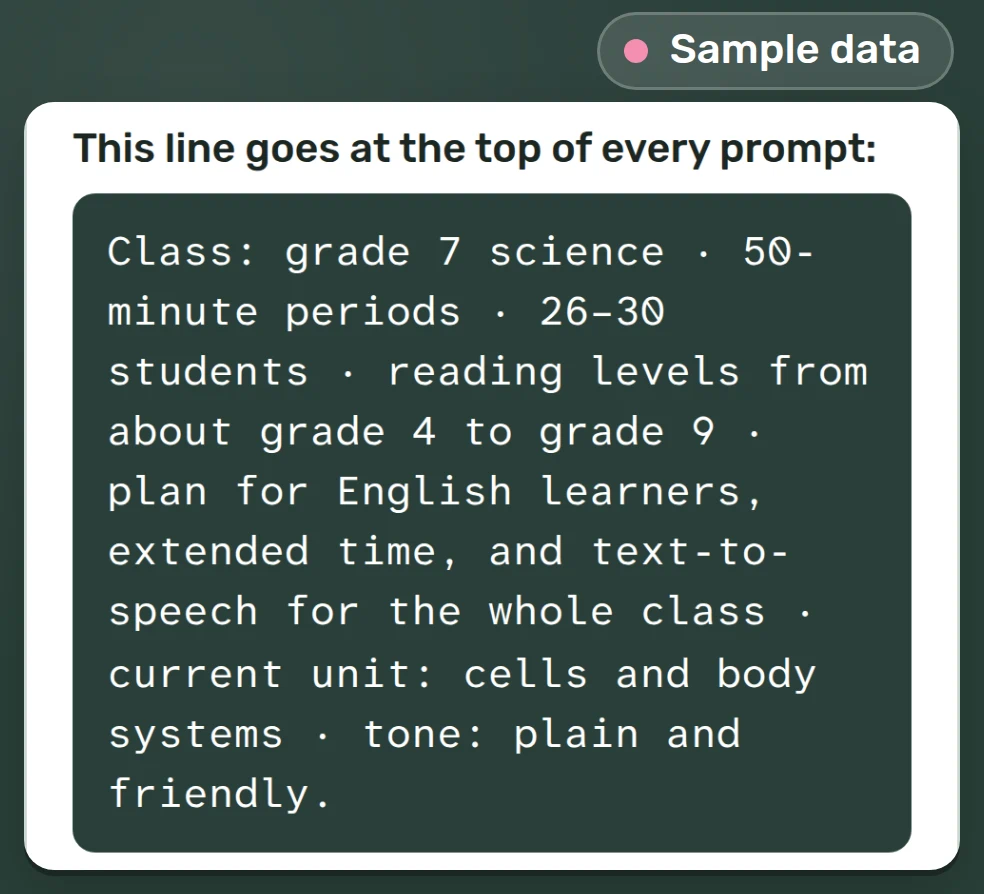
You fill in your class profile once. Eight fields: grade, subject, class length, class size range, reading range, the supports you plan for, tone, and your current unit. The profile is saved in your browser.
Then you pick a task from the 9 folders and fill in the task details it asks for, such as the topic and the objective. The builder puts your class profile at the top of that prompt, adds the format to answer in and a line asking the AI to flag anything it isn't sure of, and gives you one block of text. You copy it and paste it into the assistant you already use.
No field asks for a student's name or any student information. Where a prompt needs something about a student, it leaves a bracket, like [type a strength], for you to fill in inside your assistant. Your class profile stays in the browser you use. It isn't sent to us.
Screenshots of the Prompt Builder.
The same request, with and without your class
One made-up class, nine tasks, one from each folder. First, the request as it might be typed into a blank chat. Then the prompt the builder makes from the same task and that class profile.
Example class (made up): grade 7 science · 50-minute periods · 26–30 students · reading levels from about grade 4 to grade 9 · plan for English learners, extended time, and text-to-speech for the whole class · current unit: cells and body systems · tone: plain and friendly.
1. Lesson Plans
Typed into a blank chat:
Write a lesson plan about cells.
Built with the class profile:
Class: grade 7 science · 50-minute periods · 26–30 students · reading levels from about grade 4 to grade 9 · plan for English learners, extended time, and text-to-speech for the whole class · current unit: cells and body systems · tone: plain and friendly.

Task: plan one 50-minute lesson on how cells form tissues, organs and organ systems. Objective: students can explain the levels of organization, from cell to organism.
Include: a warm-up, a short explanation, a hands-on or visual activity, guided practice, independent practice and an exit ticket. For each part, add one of the supports listed above.
Format: headings and bullet points, one page.
Check: if anything you need is missing, ask me before you start. Mark any fact you're not sure of so I can check it.
2. Rubrics
Typed into a blank chat:
Make a rubric for a science paragraph.
Built with the class profile:
Class: grade 7 science · 50-minute periods · 26–30 students · reading levels from about grade 4 to grade 9 · plan for English learners, extended time, and text-to-speech for the whole class · current unit: cells and body systems · tone: plain and friendly.

Task: write a 4-level rubric for a one-paragraph explanation of how two body systems work together.
Criteria: scientific accuracy, use of evidence, science vocabulary, clarity. Write every level in words a grade 7 student can read, under 25 words each.
Format: a table with the criteria down the left side and the levels across the top.
Check: if anything you need is missing, ask me before you start. Mark any fact you're not sure of so I can check it.
3. Differentiation
Typed into a blank chat:
Make this reading easier.
Built with the class profile:
Class: grade 7 science · 50-minute periods · 26–30 students · reading levels from about grade 4 to grade 9 · plan for English learners, extended time, and text-to-speech for the whole class · current unit: cells and body systems · tone: plain and friendly.

Task: rewrite the reading below at three reading levels: about grade 4, grade 7 and grade 9. Keep the same facts and the same five vocabulary words in all three, with a short definition the first time each word appears.
Reading: [paste the reading here]
Format: three versions, each with its reading level as a heading.
Check: if anything you need is missing, ask me before you start. Mark any fact you're not sure of so I can check it.
4. Quizzes and Checks
Typed into a blank chat:
Write a quiz on cell organelles.
Built with the class profile:
Class: grade 7 science · 50-minute periods · 26–30 students · reading levels from about grade 4 to grade 9 · plan for English learners, extended time, and text-to-speech for the whole class · current unit: cells and body systems · tone: plain and friendly.

Task: write a 10-question check on cell organelles: 6 multiple choice, 3 short answer and 1 diagram to label. Objective: students can describe what the nucleus, cell membrane, mitochondria and chloroplasts do.
Mark each question as recall or understanding. Use plain words that fit the reading range above.
Format: the questions first, then the answer key.
Check: if anything you need is missing, ask me before you start. Mark any fact you're not sure of so I can check it.
5. Family Emails
Typed into a blank chat:
Write an email to parents about a lab.
Built with the class profile:
Class: grade 7 science · 50-minute periods · 26–30 students · reading levels from about grade 4 to grade 9 · plan for English learners, extended time, and text-to-speech for the whole class · current unit: cells and body systems · tone: plain and friendly.

Task: write an email to families about next week's lab on the heart and lungs: what students will do, what to wear, and one question families can ask at home.
Keep it under 150 words, in plain language, and end with how to reach me.
Format: a subject line, then the email.
Check: if anything you need is missing, ask me before you start. Mark any fact you're not sure of so I can check it.
6. Report Card Comments
Typed into a blank chat:
Write report card comments for science.
Built with the class profile:
Class: grade 7 science · 50-minute periods · 26–30 students · reading levels from about grade 4 to grade 9 · plan for English learners, extended time, and text-to-speech for the whole class · current unit: cells and body systems · tone: plain and friendly.

Task: write three report card comment drafts for this unit. Use [Name] in place of the student's name and they/them as the pronoun. Strength to mention: [type a strength]. Next step: [type a next step].
Each comment under 400 characters. No grades, scores or comparisons with other students.
Format: three numbered drafts.
Check: if anything you need is missing, ask me before you start. Mark any fact you're not sure of so I can check it.
7. Sub Plans
Typed into a blank chat:
Write sub plans for science.
Built with the class profile:
Class: grade 7 science · 50-minute periods · 26–30 students · reading levels from about grade 4 to grade 9 · plan for English learners, extended time, and text-to-speech for the whole class · current unit: cells and body systems · tone: plain and friendly.

Task: write a 50-minute plan for a substitute during this unit, for a day I'm out with no notice. No lab equipment and no devices.
Include: directions the substitute can read aloud, a review activity, an answer key and an early-finisher task.
Format: one page, with the time for each part in the margin.
Check: if anything you need is missing, ask me before you start. Mark any fact you're not sure of so I can check it.
8. Classroom Routines
Typed into a blank chat:
Give me a routine for lab days.
Built with the class profile:
Class: grade 7 science · 50-minute periods · 26–30 students · reading levels from about grade 4 to grade 9 · plan for English learners, extended time, and text-to-speech for the whole class · current unit: cells and body systems · tone: plain and friendly.

Task: write a routine for the start of a lab day: coming in, picking up materials, a safety check, and starting the warm-up.
Write it two ways: as a slide students can follow on their own, and as two sentences I can say out loud.
Format: numbered parts, short lines.
Check: if anything you need is missing, ask me before you start. Mark any fact you're not sure of so I can check it.
9. Feedback on Student Work
Typed into a blank chat:
Give feedback on this paragraph.
Built with the class profile:
Class: grade 7 science · 50-minute periods · 26–30 students · reading levels from about grade 4 to grade 9 · plan for English learners, extended time, and text-to-speech for the whole class · current unit: cells and body systems · tone: plain and friendly.

Task: give feedback on the student paragraph below. The name has been removed.
Write three parts: one thing that works, one thing to fix, and one question that pushes the thinking further. Write it to the student, at a grade 7 reading level, in under 80 words. Don't give a grade.
Paragraph: [paste the paragraph here, without the name]
Format: three short labeled parts.
Check: if anything you need is missing, ask me before you start. Mark any fact you're not sure of so I can check it.
The class line is the same in all nine. It was typed once, in the profile.
What the assistant sends back still depends on the assistant. The builder changes what it receives.
A blank chat, a prompt list, a platform, or this kit
A blank chat, free or paid. It knows your class only if you type your class in, every time. For a one-off question, that's enough.
Prompt lists. Good ideas for what to ask. The class details are still yours to add, by hand, to each one.
A teacher AI platform. Tools built for many tasks, often on a free plan. It's another account, and you work inside it. If you use one and like the results, keep it.
Saved instructions in your assistant. Some assistants let you save details about yourself. If your class is already in there and the answers fit, you may not need this.
The Chalkprompt Kit. Your class profile in every prompt, prompts grouped by teacher task, a format and a check line in each one, a 20-page Checking Guide, and no field for student names. It works inside the assistant you already use.
Try It on Next Week's Lesson
Build a prompt for a lesson you're actually teaching. If it doesn't fit how you work, email us within 30 days.
30-day money-back guarantee: email support@chalkprompt.online within 30 days of your purchase and you'll get a full refund of that purchase.
The 9 folders
320 prompts, each written around one teacher task:
Lesson Plans
Rubrics
Differentiation
Quizzes and Checks
Family Emails
Report Card Comments. Prompts that ask your assistant for comment drafts, with [Name] in place of a name.
Sub Plans
Classroom Routines
Feedback on Student Work. You paste the work with the name removed.
Also in the kit:
The Prompt Builder. A web tool on your access page. Pick your grade band (K–2, 3–5, 6–8 or 9–12) and your subject, fill in your class profile, pick a task, copy.
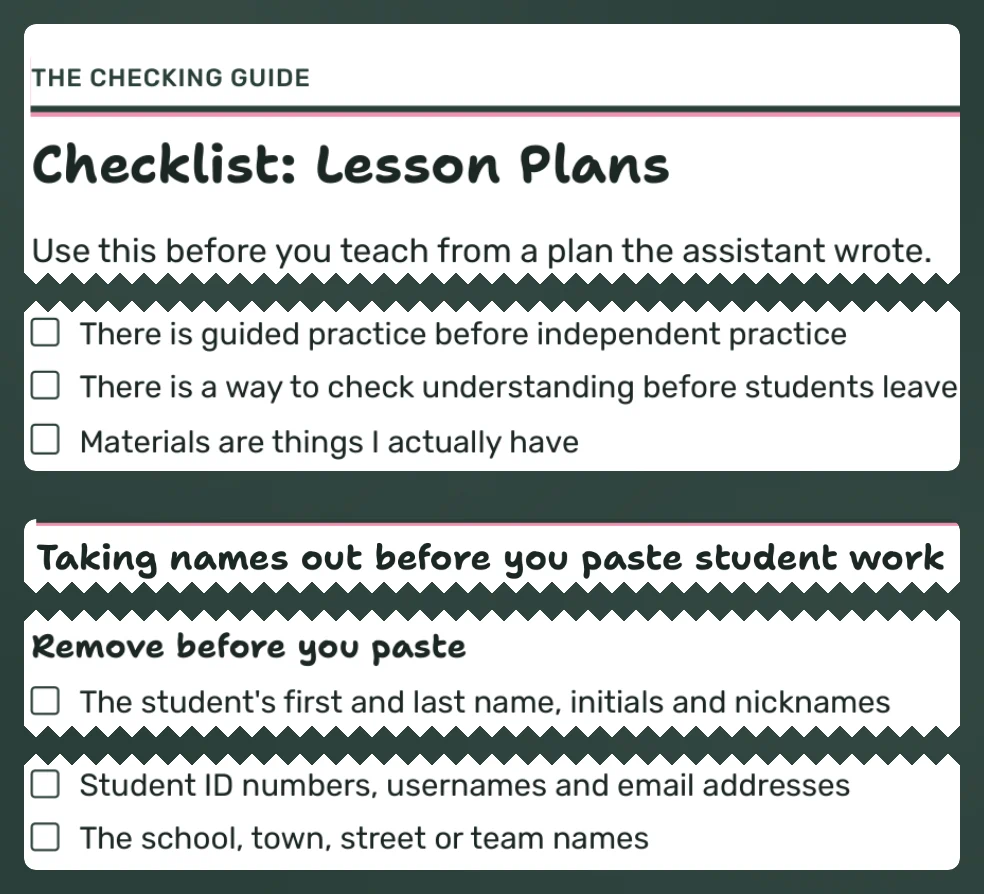
The Checking Guide. PDF, 20 pages. What to check before you use an answer: facts, reading level, bias, the lesson objective and sources. How to take names out before you paste student work. A checklist for each task.
All 320 prompts as a PDF, too.
The 9 side-by-side examples above, on your access page.
Quick Start, one page, and email support for 12 months.
Screenshots of the Checking Guide.
Out of scope
It isn't an AI, and no assistant is included. You use the one you already have, free or paid.
It doesn't write anything by itself. It builds the prompt. The assistant writes. You check.
It can't make every answer right. A fuller prompt gives the assistant more to work with, and the Checking Guide is there for what comes back.
It doesn't claim alignment to state standards. The prompts ask the AI to tie the work to the objective you enter.
It never asks for student information. What you paste into your assistant is up to you, and the guide shows how to take names out first.
Before summer
Summer has the time. The school year has the tasks: report card comments when the grading period closes, a sub plan for the day you're out with no notice, next week's lessons. The folders for those three hold 30, 30 and 48 prompts. The profile you fill in today goes into every one of them.
One-time payment. No subscription. Access doesn't expire. Your downloaded files are yours to keep. If we ever retire one of the web tools, we'll email you at least 60 days before and give you its content as files you can keep.
Right after checkout, we email you a link to your access page. The Prompt Builder is the first thing on it.
30-day money-back guarantee: email support@chalkprompt.online within 30 days of your purchase and you'll get a full refund of that purchase.
Questions
Does it include an AI?
No. It works with the AI assistant you already use, free or paid. You copy the prompt and paste it there.
Which assistants can I use it with?
The prompts are plain text, so you can paste them into any chat-based assistant. How good the answer is depends on the assistant.
Do I have to type my class in every time?
No. You fill in your class profile once, and the builder puts it in every prompt. It's saved in the browser you use, so on a new computer or phone you fill it in again.
Does it ask for student names or data?
No field asks for a student's name or any student information, and your class profile isn't sent to us. When you paste student work into your assistant, the Checking Guide shows how to take names out first.
My grade or subject is different. Will it fit?
Pick your grade band (K–2, 3–5, 6–8 or 9–12) and your subject, then fill in your class profile. The prompts are written around teacher tasks, and the profile puts your class into each one.
Is it standards-aligned?
We don't claim that. The prompts ask the AI to tie the work to the objective you enter.
How do I get it?
Right after checkout, we email you a link to your access page, where the Prompt Builder and the files are. Access doesn't expire. Your downloaded files are yours to keep. If we ever retire one of the web tools, we'll email you at least 60 days before and give you its content as files you can keep.
What if it doesn't fit how I work?
30-day money-back guarantee: email support@chalkprompt.online within 30 days of your purchase and you'll get a full refund of that purchase.
One profile, every prompt
Write your class profile, and every prompt carries it from then on.